


Friday’s Change Reflection Quote – Saeculum Leadership® – Leaders Read Signals Early

🎓 FCRQ215 Leadership Learning!
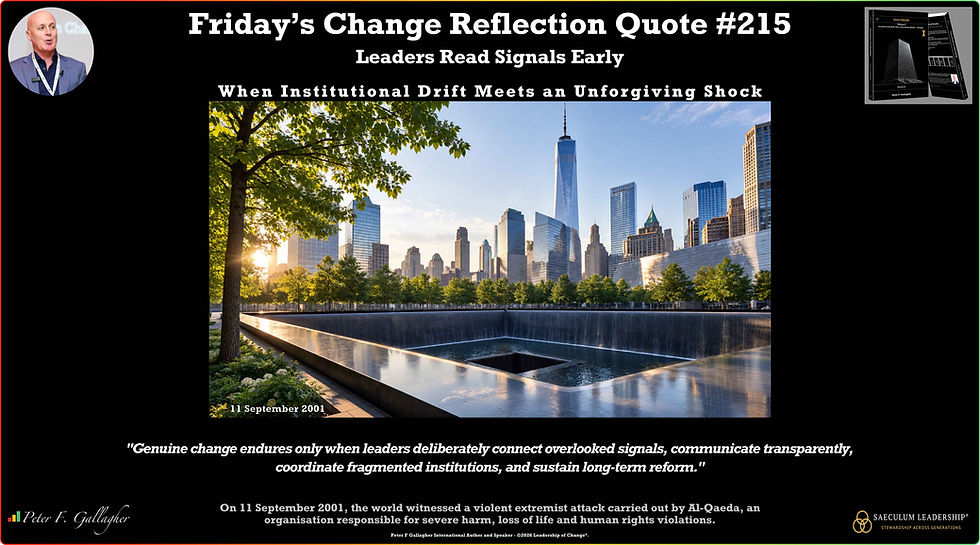
On 11 September 2001, the world witnessed a violent extremist attack carried out by Al-Qaeda, an organisation responsible for severe harm, loss of life and human rights violations. Nineteen hijackers seized control of four commercial passenger aircraft, exploiting long-standing gaps within international aviation security screening procedures. Two aircraft struck the twin towers of the World Trade Center in New York, causing both structures to collapse. A third aircraft struck the Pentagon in Washington, severely damaging the headquarters of the United States military establishment. Passengers aboard the fourth aircraft confronted the hijackers, forcing it down before it could reach its intended target in Washington. It came down in a field near Shanksville, Pennsylvania, killing everyone aboard. Almost three thousand people lost their lives across the four locations, including hundreds of emergency responders who entered the burning towers. Subsequent investigations revealed that intelligence agencies had gathered relevant warning signals well before the attacks occurred. Warning signals were present across the intelligence and security system, but they were not sufficiently connected, interpreted or escalated across institutional boundaries. Within days, national leaders faced immediate pressure to communicate publicly, reassure populations and coordinate emergency response across multiple jurisdictions. Longer-term consequences included extensive reform of aviation security procedures, intelligence coordination structures and homeland security policy internationally. The attacks triggered prolonged military, diplomatic and institutional shifts that reshaped international security for decades. Financial markets experienced significant disruption, while aviation, insurance and tourism industries faced sustained operational and financial pressure. Government agencies faced intense scrutiny over the information gaps identified, prompting significant restructuring of oversight and accountability mechanisms. Official commissions later demonstrated how fragmented information architecture prevented a coherent operational picture from forming across departments. Two decades later, the events remain a defining reference point for discussions of institutional preparedness and crisis leadership. They continue to inform how organisations build resilience, integrate fragmented systems and sustain long‑term reform beyond immediate recovery. The scale and visibility of the losses forced institutions worldwide to reconsider long-held assumptions about vulnerability and preparedness. Many businesses subsequently revised continuity planning, security protocols and internal communication approaches in direct response to the lessons learned.
Within Saeculum Leadership® thinking, 11 September 2001 is understood as a Strong Signal: an abrupt systemic shock that exposed weaknesses in the prevailing institutional order and forced a fundamental reassessment of security, preparedness and leadership responsibility. It disrupted long‑standing assumptions about security and preparedness, forcing leaders worldwide to reconsider the responsibilities embedded within institutional stewardship.
✅ Saeculum Leadership® Lessons: The deeper leadership lesson lies not in the events themselves, but in the structural failures they exposed across the systems responsible for protecting public safety. Saeculum Leaders change outcomes by connecting weak or isolated signals across systems before they escalate into major crises. They communicate quickly and clearly whenever public trust and safety are placed under severe and sustained pressure. Saeculum Leaders integrate fragmented agencies and departments deliberately, closing dangerous gaps that undermine shared critical information. They design organisations capable of resilience, embedding distributed systems and contingency planning that withstand sudden and severe shocks. Saeculum Leaders pursue sustained reform, embedding long-term institutional change rather than relying on temporary reactive measures. Leaders Read Signals Early.
“Genuine change endures only when leaders deliberately connect overlooked signals, communicate transparently, coordinate fragmented institutions, and sustain long-term reform.”
🏛 From the Canon — Practice 5 — System Stewardship: The attacks exposed how rapidly a shock can amplify underlying weaknesses when institutional architecture is drifting and coherence is eroding. The 11 September attacks exposed how fragmented intelligence structures, disconnected signals and weak cross‑agency integration can allow critical information to remain invisible at precisely the moment it is most needed. System Stewardship requires leaders to examine how information moves, where it stalls, and how institutional architecture either enables or obstructs coherent understanding.
Stewardship operates at the level of architecture rather than tools. It demands that leaders recognise when emerging risks, behaviours or signals begin influencing systems before their consequences become visible. The responsibility is not simply to improve processes, but to redesign the frameworks through which relevance is determined, threats are interpreted and decisions are shaped. When architecture is weak, behaviour becomes unpredictable; when architecture is strong, organisations act with clarity even under severe pressure.
Saeculum Leaders intervene early, strengthening systems that support coherence, resilience and informed action. They build structures that transmit disciplined judgement across generations, ensuring future leaders inherit systems capable of recognising signals, integrating information and reducing the risk of catastrophic drift. This is the work of leaders who steward tomorrow’s architecture rather than inherit yesterday’s assumptions.
🔍 The Stewardship Reflection Lens:
What are we inheriting?
We inherit systems already shaping how people interpret their environment, connect signals and make decisions.
How should we steward it?
We steward systems by strengthening the architectures through which clarity, relevance and disciplined knowledge move across institutional boundaries.
What legacy are we creating?
We create legacy when the systems we build guide behaviour long after our leadership ends, transmitting coherence across generations.
Further Reading: Further Reading: Saeculum Leadership® Body of Knowledge (SLBoK). Saeculum Leadership®: Doctrine – Volume I.
About the Friday Change Reflection Quotes (FCRQs):
The objective of the Friday Change Reflection Quotes (FCRQs) is to provide insightful reflections on leadership and change management, drawing lessons from historical figures and events to inspire organisations and their leaders to step up to their change responsibilities. By promoting lifelong continuous learning and professional development, FCRQs aim to elevate the change management profession beyond dilettantism while improving both organisational performance and society at large. This initiative directly confronts the organisational change management charade, challenges acts of implementation insanity, and works to prevent the repeated failure of expensive change and transformation efforts. Each reflection is grounded in the principles of Saeculum Leadership®, which recognises that enduring change is generational, not episodic. It demands leaders who design systems that outlast their tenure, encode values into structure, and steward transitions with clarity and courage. Within this canon, every historical moment becomes a Signaig—a signal act of leadership that encodes doctrine, direction, and durability. These Signaigs are not merely symbolic; they are instructive artefacts that reveal how leaders intervene, model, and envision change that endures beyond crisis, personality, or short-term gain.
#SaeculumLeadership #Leadership #LeadershipofChange #FCRQ #KnowledgeArchitecture #SystemStewardship #InstitutionalStewardship #GenerationalResponsibility #ChangeLeadership #LeadershipDevelopment #Google #LarryPage #SergeyBrin
Peter F. Gallagher is the Founder–Architect of Saeculum Leadership®, a doctrine of generational stewardship that equips leaders to strengthen what they inherit and shape what future generations receive. A 21-book author, global keynote speaker, and trusted advisor to boards, CEOs, and executive leadership teams, he helps organisations strengthen leadership capability, institutional stewardship, and transformational change in an increasingly complex world.
Recognition:
Most leaders manage change. Saeculum Leaders manage history.
For speaking engagements, board advisory, executive leadership programmes, or enquiries regarding Saeculum Leadership®, contact Peter.Gallagher@a2B.consulting.
Saeculum Leadership® Body of Knowledge (SLBoK) - Volumes 1–10, A–E, and 0, I–V

Comments