


AI‑Driven Change Is Now a Core Leadership Duty (Not a Project)

Updated: Dec 14, 2025
"Change waits for no leader. All leadership is ultimately about change and improvement.""Change waits for no leader. All leadership is ultimately about change and improvement."
In 2026, that truth becomes non‑negotiable.
Artificial intelligence is now transforming organisations faster than any traditional change method can cope with. By 2026, AI is no longer a technology trend — it is the primary driver of organisational transformation, competitive advantage, and value creation. The leaders who still treat AI‑driven change as “an IT project” or “something the change team handles” will simply be too late.
This new reality demands a new leadership discipline. I call it AI‑OCM Leadership — the ability to lead Artificial Intelligence–enabled Organisational Change Management with the same rigour, ownership, and moral clarity that leaders bring to strategy, operations, or finance. AI‑OCM Leadership is not a framework. It is a leadership doctrine. It defines what leaders must do when technology, people, and purpose collide.
The old model is dead. You cannot delegate transformative change to an internal change team or even to the most expensive external consultants and expect the new way of working to stick. Without active, visible, and consistent involvement from the top, transformation receives second‑tier resources, sporadic air cover, and quietly dies while everyone clings to business‑as‑usual.
AI‑OCM Leadership flips the script. It makes leading change a core leadership duty — not a side activity. There are three non‑negotiable responsibilities:
1. Articulate the Change Vision
Leaders must paint a vivid, compelling picture of the future state — how the organisation, its products, and its services will look and perform once the change is embedded. In an AI‑enabled world, this vision must explicitly show how technology and people will coexist, collaborate, and co‑create value. It must excite the mind, stir the heart, and give everyone a clear “why.”
A leader who cannot articulate the future cannot lead the organisation into it.
2. Model the New Way
Employees do what they see, not what they’re told. Leaders must be the first adopters: using the new tools in public, making decisions the new way, prioritising the new metrics, and visibly shifting their own time and attention. When the executive team still runs the company on spreadsheets while preaching AI, the transformation is already doomed.
Modelling is not symbolic. It is the mechanism through which culture changes.
3. Intervene to Ensure Sustainable Change
Implementation is only the halfway point. Leaders must actively monitor adoption, remove blockers, confront resistance (including from fellow executives), and reinforce the new behaviours until they become the default. Without deliberate intervention, organisations revert in weeks.
Sustainability is not an outcome. It is a leadership behaviour.
The Proof Is Already Here
✅ Microsoft: The Positive Case
Satya Nadella personally articulated the cloud + AI vision, modelled it by restructuring the entire company around it, and intervened repeatedly to remove barriers and kill sacred cows. Outcome: Microsoft’s market cap rose from ~$300B in 2014 to over $4T by 2025 — the largest value creation story of the decade.
✅ General Electric: The Cautionary Tale
Successive CEOs delegated “digital transformation” to a separate unit while running the core business the old way. Outcome: Billions written off, a failed digital strategy, and the eventual breakup of one of the world’s most iconic industrial companies.
✅ EY: The Modern AI Case
EY acted as “Client Zero” for its own AI transformation — CEO‑led, human‑centred, and enterprise‑wide. Outcome: A $1.4B investment that reshaped internal operations and client delivery, proving that AI‑OCM Leadership scales.
The gap between these outcomes is not technology. It is leadership — specifically, AI‑OCM Leadership.
2026: The Year the Curve Goes Vertical
2026 is not a distant horizon. It is the year AI adoption becomes mainstream across industries. The leaders who master these three responsibilities — articulate, model, intervene — will pull away from the pack. The ones who don’t will discover that change waited for no one.
The question every executive must answer today:
Are you still delegating your organisation’s future — or are you ready to lead it?
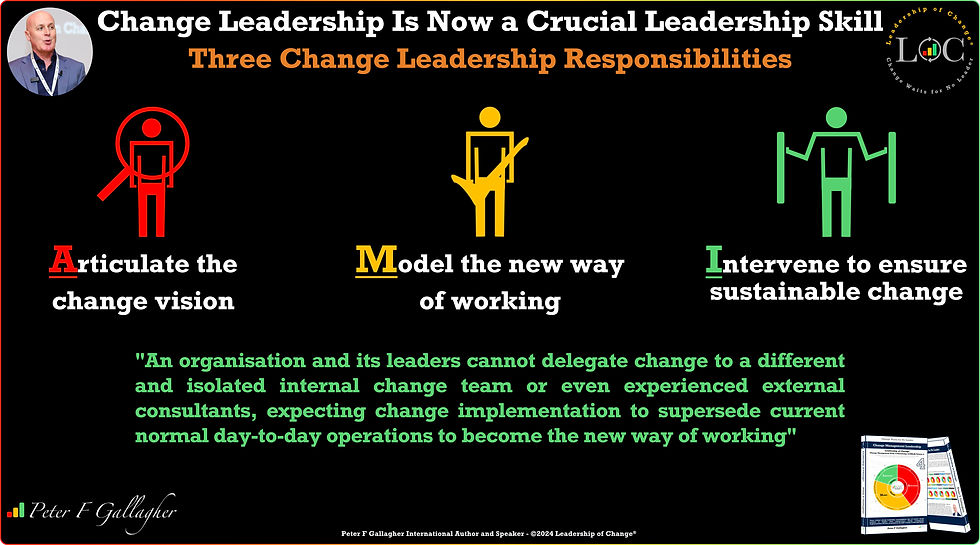
In today’s rapidly evolving landscape, leading organisational change has become an essential capability for effective leadership. The stakes are high: failure to lead change can result in significant financial losses, diminished employee morale, and a rapid erosion of competitive advantage. Organisations that resist or mishandle change risk stagnation, obsolescence, and a breakdown of trust among employees and stakeholders.
The consequences extend far beyond the workplace. Job losses can devastate families and communities, creating financial strain and emotional turmoil across entire regions. As disruptive forces—especially AI‑driven technologies and shifting customer expectations—continue to reshape industries, leaders must adopt a proactive, disciplined, and accountable approach to change. Only by cultivating true leadership‑of‑change excellence can organisations navigate complexity, accelerate transformation, and secure long‑term sustainability.
An organisation and its leaders cannot delegate change to an isolated internal change team or even to experienced external consultants, expecting implementation to somehow supersede day‑to‑day operations and become the new way of working. How can the new way of working be adopted, deliver return on investment, improve operational performance, create future revenue, and generate competitive advantage without active, visible, and consistent leadership involvement?
Worse still, when leaders remain focused solely on business‑as‑usual, the change team will not receive the quality resources, sponsorship, or organisational agenda time required for successful implementation. There are three critical leadership‑of‑change responsibilities:
Articulate the Change Vision:
The first responsibility of change leadership is about creating and ‘Articulating the change vision’. This vision should succinctly describe how the organisation, product, or service will look after the change is successfully implemented. It should be bold but realistic; it should paint a vivid picture of the future state that appeals to the employee’s hearts and minds, especially their purpose.
Model the New Way:
The second responsibility for the leadership team in implementing their organisation’s change is to ‘Model the new way’. This is about making the leader’s change vision a reality by modelling the new way of working. The organisation and employees will adopt change when leaders show and model the new way.
Intervene to Ensure Sustainable Change:
The final responsibility for the leadership team in fully implementing their organisation’s change is ‘Intervene to ensure sustainable change’. Now that the leader’s change vision has been implemented, this is about making it sustainable and normal day-to-day operations. Without intervention from leaders, the change will not be adopted or sustained.
"Organisational change leadership is about effectively and proactively articulating the vision, modelling the new way, and intervening to ensure sustainable change. These are crucial leadership skills."
This blog is based on my book:
Buy the book?

Peter consults, speaks, and writes on the Leadership of Change®.
He works exclusively with boards, CEOs, and senior leadership teams to prepare and align them to effectively and proactively lead their organisations through change and transformation.
For insights on navigating organisational change, feel free to reach out at Peter.gallagher@a2B.consulting or schedule a free consultation

Peter F. Gallagher is a leadership guru, change management global thought leader, organisational change authority, international corporate conference speaker, 15X author, and C-level change leadership.
Listed #1 by leadersHum Top 40 Change Management Gurus You Should Follow in 2022 (Mar 2022).
Ranked #1 Change Management Global Thought Leader: Top 50 Global Thought Leaders and Influencers on Change Management (2024-2023-2022-2021-2020) by Thinkers360.
Listed #15 in the “Top 30” for Global Gurus Leadership (2024) by Global Gurus.
Ranked #1 Business Strategy Global Thought Leader: Top 50 Global Thought Leaders and Influencers on Business Strategy (2022) by Thinkers360.
Ranked #6 Leadership Global Thought Leader: Top 50 Global Thought Leaders and Influencers on Leadership (April 2024) by Thinkers360.
Business Book Ranking
Change Management Behaviour - Leadership of Change® Volume 6, listed among the 50 Books from Thinkers360 Thought Leaders to read in 2022.
Change Management Adoption - Leadership of Change® Volume 5, listed among year-to-date’s (Jul 2021) most popular books on business and technology from Thinkers360 member thought leaders.
Change Management Handbook - Leadership of Change® Volume 3, listed among the 50 Business and Technology Books from Thinkers360 Thought Leaders to read in 2021.
Change Management Pocket Guide - Leadership of Change® Volume 2, ranked within the top 50 Business and Technology Books (Jan 2020) from Thinkers360 Thought Leaders.
Comments